

| Ethical Governance and Risk Management
Corporate Governance Structure and Board Oversight
- Supreme Oversight: The Board of Directors serves as tsti's highest governance body, guiding corporate strategy, supervising executive management, and maintaining accountability to the company and its shareholders. The current 9th Board of Directors serves a three-year term ending on May 27, 2027, and was re-elected on May 28, 2024.
- Board Composition and Diversity: The Board consists of eight Directors, including two Independent Directors and two female Directors. Independent Directors represent 25% of the total board membership. The directors possess diverse backgrounds, combining professional expertise in operational judgment, accounting and financial analysis, business management, crisis management, legal compliance, and ESG knowledge.
- Key Board Appointments and Transitions: Mr. Chang (who concurrently serves as Chairman of Tatung Co., Ltd.) was appointed Chairman of the Board on October 9, 2025, succeeding Mr. Wu who was originally elected in June 2024. Other representative changes occurred during 2025 and 2026, including Director Lu being succeeded by Director Chang in February 2026, and Director Yang being succeeded by Director Yang in May 2026.
- Independent Director Resignations and By-Elections: Following the resignations of Independent Directors Mr. Shih and Mr. Yeh in late 2024, a by-election at the 2025 Annual General Shareholders' Meeting elected Mr. Huang and Mr. Chen. However, Mr. Chen subsequently resigned in October 2025, and Mr. Huang resigned in April 2026.
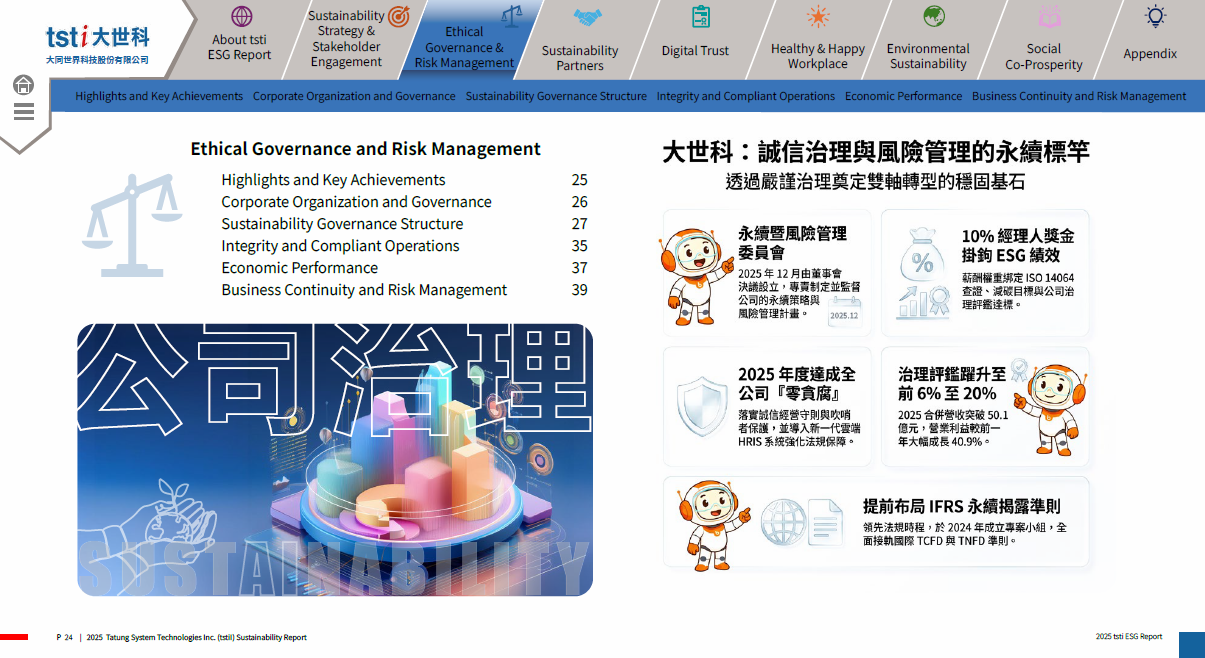
- Corporate Governance Evaluation: tsti has progressively improved its performance in the Corporate Governance Evaluation for TPEx-Listed Companies. The company rose from the 36%–50% bracket to the 21%–35% bracket in the 2024 announcement, and successfully ranked in the 6%–20% bracket in the 11th evaluation for 2024 (announced in 2025).
- Conflict-of-Interest Recusal: Strict recusal protocols are enforced under tsti's Procedures and Behavioral Guidelines for Ethical Management. Directors who have a personal interest or represent a legal entity with a conflict of interest must explain the conflict during board meetings and recuse themselves from deliberations, voting, and serving as proxies.
- Board Continuing Education: In 2025, board members participated in continuing education for a total of 22 person-times, accumulating 72 training hourss. Course topics covered directors' fiduciary responsibilities, green finance, the EU CBAM, fraud prevention, legal risks of AI-Generated Content (AIGC), and corporate bullying prevention.
Dedicated Functional and Sustainability Committees
The Board has established functional committees to identify, oversee, and manage operational risks and impacts:
- Audit Committee: Composed of Independent Directors and chaired by Independent Director Tai-Feng Huang, this committee meets at least once per quarter to supervise financial reporting and internal controls. It convened 4 meetings in 2025 with a member attendance rate of 100%.
- Remuneration Committee: Convened by Independent Director Jung-Ying Tai, this committee regularly evaluates the effectiveness and fairness of the corporate remuneration policy. It held 4 meetings in 2025 with a 100% attendance rate.
- Sustainability and Risk Management Committee: Approved and established by the Board on December 19, 2025, the committee's founding members included Director Kuo, Director Lu, and President Liu. It is tasked with formulating sustainability plans, reviewing the ESG report, and monitoring risk management execution.
- Sustainability and Risk Management Task Force: This task force manages four functional subcommittees—Corporate Governance and Risk Management, Sustainable Environment and Risk Management, Social Responsibility and Risk Management, and Business Continuity and Risk Management—which report directly to the Chairman and the Board. The team (previously the Sustainable Development Promotion Team) convened 4 regular meetings in FY2025.
- IFRS Sustainability Disclosure Alignment: Although tsti's paid-in capital is under NT$5 billion (requiring IFRS adoption by 2028), the company established a cross-departmental IFRS Task Force in Q4 2024 to execute an accelerated trial timeline that aligns with its parent company, Tatung Group. Phase I analysis and planning is scheduled for completion by Q4 2026.
Integrity, Compliance, and Whistleblowing Mechanisms
- Zero-Tolerance for Corruption: Managed by the Human Resources Department, tsti actively promotes anti-corruption guidelines. In 2025, no employees were involved in corruption incidents, and no partnerships were terminated due to corruption. tsti experienced zero whistleblower reports regarding ethical management between 2023 and 2025.
- Whistleblower Protections: Whistleblowing reports are immediately escalated to the President and handled with strict confidentiality. Whistleblowers are protected from retaliation, and all case documentation is retained for five years.
- Labor Compliance and Rectification: Due to two Labor Standards Act incidents at the end of 2024, tsti paid fines totaling NT$100,000 in 2025. The company fully rectified these issues by issuing back-pay and deploying a new cloud-based Human Resources Information System (HRIS) featuring automated overtime calculations and early-warning alerts.
- Compliance and Legal Affairs: To strengthen compliance training, tsti established a new Legal Affairs Department in late 2024. Compliance information is systematically published on the corporate intranet, KMS, and mobile office platforms.
- Employee Confidentiality: To strengthen privacy information management in alignment with its ISO/IEC 27701:2019 certification, tsti required newly hired employees to sign an Employee NDA/Confidentiality Undertaking beginning in April 2025.
ESG-Linked Executive Remuneration
- Bonus Weighting Structure: Annual executive performance evaluations directly link compensation to corporate sustainability, weighting 90% on financial performance and 10% on non-financial sustainable governance (ESG) targets.
- ESG Metrics: Non-financial targets include corporate governance compliance, information security management, climate change risk response, and environmental and social responsibility goals.
- Phased Objectives:
- Short-term (~2025): Formulating sustainability performance metrics and the linkage plan for division-level heads and above.
- Medium-term (2026–2027): Evaluating the system's effectiveness and refining procedural details.
- Long-term (2027~): Expanding the implementation of sustainability-linked performance metrics across all organizational levels.
Business Continuity and Risk Management
- Risk Policies and Procedures: Formulated and approved by the Board on November 7, 2023, these policies comply with FSC internal control regulations to protect stakeholder rights and evaluate risk-bearing capacity.
- Risk Scope: The company’s risk management covers four operational dimensions: Environment (including climate), Social, Governance, and Technology. The risk management operational status is reported to the Board at least once annually, with the 2025 report presented on December 19, 2025.
- Intellectual Property (IP) Management: Governed by the Intellectual Property Management Regulations promulgated in June 2023, IP processes are managed by the Administrative Operations Center. Employment contracts explicitly assign duty-related IP rights to the company, and an IP advocacy seminar was conducted on October 14, 2025, to raise employee awareness.
- Tax Governance: Under CFO oversight, the Accounting Department acts as the managing unit. tsti adheres to strict legal compliance, timely filing, and the arm's length principle for related-party transactions, undergoing tax audits every five years to manage regulatory exposuree.