

| Sustainability Strategy & Stakeholder Engagement
Sustainable Development
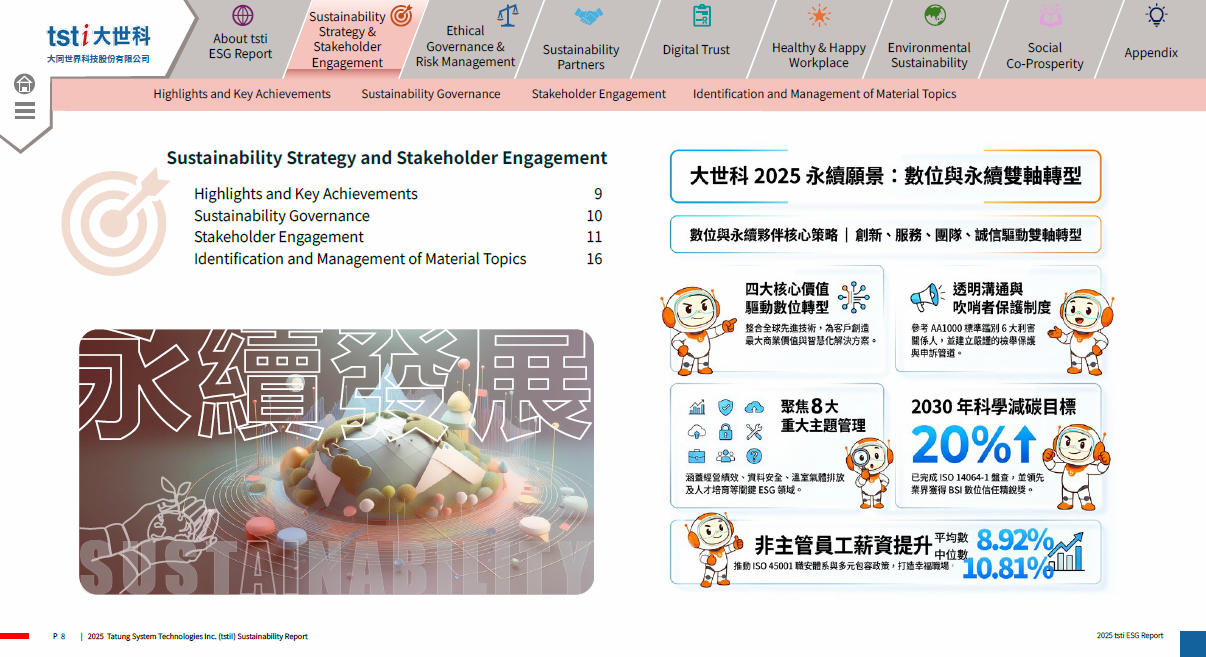
Tatung System Technologies Inc. (tsti) comprehensively promotes its sustainability strategy centered on the core concept of "Sustainable Partnerships". The strategy seamlessly integrates information and communications technology (ICT) expertise with environmental stewardship, social co-prosperity, and ethical governance to drive a unified "Twin-Axis Transformation" (Digital and Sustainability).
The key elements of tsti's 2025 Sustainability Strategy include:
1. Strategic Vision, Mission, and Core Values
- Twin-Axis Vision: tsti’s vision is to serve as an operational benchmark for innovation and service competitiveness in the ICT service industry, striving to become the premier integrator and practitioner of Twin-Axis Transformation.
- Transformation Mission: The company's mission is to integrate advanced digital technologies to create maximum value for clients and assist government agencies and enterprises in driving digital and sustainability transformations.
- Bedrock Values: The strategy is driven by four core value propositions: Innovation (the driving force of progress), Service (the cornerstone of long-term trust), Teamwork (the foundation for technology solutions), and Integrity (the bedrock of corporate sustainability).
2. Enhanced Sustainability Governance Structure
To embed sustainability directly into corporate oversight, tsti upgraded its governance structure in 2025:
- Sustainability and Risk Management Committee: tsti established this committee, formulated its formal charter, and revised the overall ESG project organizational structure. The Board of Directors receives quarterly progress reports from the management team to monitor and adjust sustainability strategies.
- Standardized Procedures: tsti revised key foundational guidelines, including the "Sustainable Development Practice Principles" and the "Procedures for the Preparation and Verification of Sustainability Reports" to reinforce corporate transparency and reporting compliance.
3. Proactive Stakeholder Engagement
- Six Stakeholder Groups: Referencing the international AA1000 Stakeholder Engagement Standard (SES), tsti identifies and engages with Shareholders / Investors, Customers, Employees, Government Agencies, Suppliers / Vendors, and Media / General Public / Local Residents & Organizations.
- Grievance and Feedback Mechanisms: tsti maintains diverse, open communication and whistleblowing channels to actively gather feedback, prevent misalignments, and mitigate operational or litigation risks.
4. Materiality Management & Core ESG Pillars
Through a structured materiality process, tsti evaluates the positive and negative impact scenarios of various sustainability issues. In 2025, tsti consolidated its focus areas from 9 down to 8 core material topics to ensure long-term focus and comparability of performance trends. These topics form the core pillars of tsti's execution strategy:
- Corporate Governance (G):
- Economic Performance: Achieving steady growth in economic performance (targeting annual double-digit growth rates) to bolster investor confidence.
- Ethical Management & Regulatory Compliance: Conducting regular site corruption risk assessments across all domestic and overseas sites and establishing a cross-functional task force to align with the IFRS Sustainability Disclosure Standards roadmap.
- Data Security and Privacy Protection: Continuously strengthening cybersecurity governance and maintaining dual ISO/IEC 27001:2022 and ISO/IEC 27701:2019 certifications to safeguard customer and business data.
- Environmental Sustainability (E):
- Carbon & Energy Management: Executing third-party verified greenhouse gas (GHG) inventories and advancing office carbon reduction measures. tsti has established a target to achieve a 20% reduction in Scope 1 plus Scope 2 GHG emissions by 2030 compared to the 2023 baseline year.
- Social Co-Prosperity (S):
- Talent and Workplace Well-being: Recognizing employees as tsti's most vital asset. Key actions include maintaining ISO 45001:2018 Occupational Health and Safety certification, optimizing performance appraisals, and joining the "TALENT, in Taiwan" Talent Sustainability Action Coalition to foster diversity, equity, and inclusion.
Please refer to the Sustainability Report [PDF] relevant chapter for more details.