

| Highlights and Key Achievements
Sustainability Strategy & Stakeholder Engagement
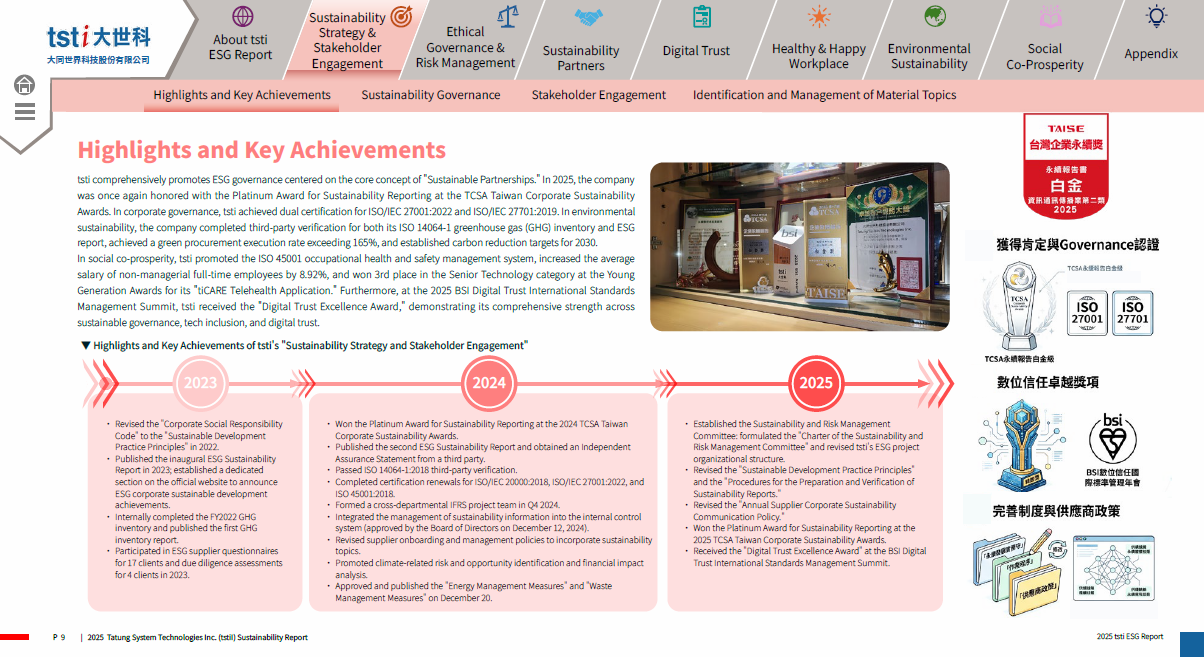
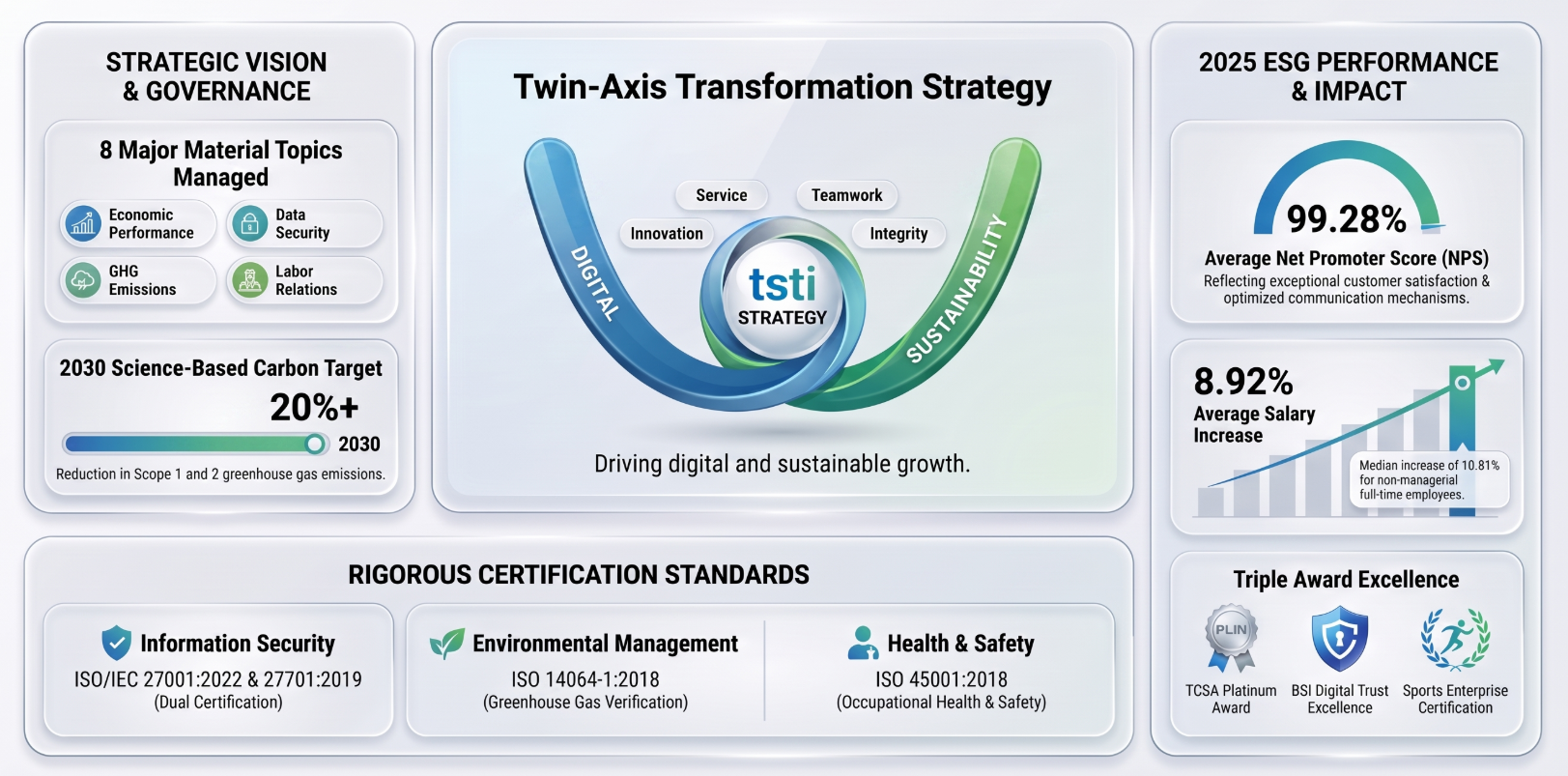
Tatung System Technologies Inc. (tsti)'s sustainability strategy, governance structures, and stakeholder engagement methodologies. This framework positions tsti's corporate identity around the core concept of "Sustainable Partnerships" and a defined mission to drive "Twin-Axis Transformation" (Digital and Sustainability).
1. Core Sustainability Vision, Mission, and Values
tsti’s sustainability strategy is anchored in a defined corporate direction that integrates advanced information and communications technology (ICT) with sustainabilit:
- The Vision: To serve as an operational benchmark for innovation and service competitiveness in the ICT service industry, striving to become the premier integrator and practitioner of Twin-Axis Transformatio.
- The Mission: To integrate global digital technologies to create maximum value for clients, assisting government agencies and enterprises in enhancing operational efficiency and achieving their digital and green transformation goal.
- Four Core Value Propositions:
- Innovation (the driving force of company progress).
- Service (the cornerstone of maintaining long-term trust).
- Teamwork (the foundation for comprehensive services and solutions).
- Integrity (the bedrock of corporate sustainability).
2. Sustainability Governance & Oversight
Governance at tsti is structured to cascade sustainability responsibilities from top leadership down to functional subcommittees:
- Board-Level Oversight: The Board of Directors regularly receives quarterly progress reports from the management team to evaluate, review, and adjust sustainability strategie.
- Sustainability and Risk Management Committee: tsti formally established this committee and formulated its charter to govern ESG project structure.
- Sustainable Development Promotion Team: This team coordinates tsti's day-to-day sustainability tasks, including evaluating greenhouse gas emissions, human rights, and information security risk. In 2025, the team convened 4 regular meetings and invited cross-departmental teams to review stakeholder communication.
- Strategic Policy Revisions: The company updated its foundational "Sustainable Development Practice Principles" and "Procedures for the Preparation and Verification of Sustainability Reports" to standardize reporting and complianc.
3. Stakeholder Engagement Framework & 2025 Achievements
By referencing the international AA1000 Stakeholder Engagement Standard (SES), tsti has identified six key stakeholder groups. To prevent misalignment, tsti engages with these groups through diverse channels, achieving several documented outcomes in 2025:
- Shareholders and Investors:
- Significance: Providing the momentum for steady growth.
- 2025 Achievements: Improved its Corporate Governance Evaluation ranking among TPEx-listed companies to the top 6%–20%. The company convened two investor conferences (May 20 and September 18, 2025),held a by-election for two Independent Directors, and published 40 material announcements.
- Customers:
- Significance: Putting client needs at the core of services.
- 2025 Achievements: Achieved an average Net Promoter Score (NPS) customer satisfaction rate of 99.28. tsti responded to 92 client ESG questionnaire instances and 28 external stakeholder cybersecurity audit requests. They also rolled out Foxit PDF software to securely sign and protect client-exchanged confidential documents.
- Employees:
- Significance: Valued as tsti's most vital partners.
- 2025 Achievements: Grew the average annual compensation of non-managerial full-time employees by 8.92% (reaching NT$952 thousand) and the median salary by 10.81% (reaching NT$789 thousand). tsti convened 4 Labor-Management Conferences for itself and subsidiary Quantek, plus 1 for subsidiary TISNet. It conducted three digital workplace climate and human rights surveys, hosted DEI workshops, and coordinated 413 training courses (totaling 17,737 training hours) supported by NT$1,430,070 in government training subsidies.
- Government Agencies:
- Significance: Ensuring compliance with local regulations.
- 2025 Achievements: Spent NT$3,308,279 on green procurement (exceeding its target by 65%), which earned tsti a Certificate of Appreciation from the Taipei City Government.
- Suppliers and OEMs:
- Significance: Building long-term strategic partnerships to maximize client benefits.
- 2025 Achievements: Handled 125 newly onboarded suppliers, 100% of whom signed the "Supplier Sustainable Responsibility Commitment Letter". The company also revised its "Annual Supplier Corporate Sustainability Communication Policy" and conducted ESG self-assessments for 30 active suppliers, including 5 on-site audits.
- Media, Public, and Community Groups:
- Significance: Effectively communicating tsti's brand image to the public.
- 2025 Achievements: Sponsored rural youth education in partnership with World Vision Taiwan and the Taiwan Fund for Children and Families (TFCF). The company also established campus internship MOUs with universities, successfully transitioning 3 interns into full-time roles in late 2025.
4. Grievance Mechanisms and Whistleblowing Safeguards
To build a transparent corporate culture, tsti maintains robust feedback and dispute channels:
- Whistleblowing System: Designed for both internal and external stakeholders to report corruption or unethical conductt. General employee reports are investigated by the HR Manager, while cases involving directors or VP-level executives are routed directly to the Audit Committee. Whistleblowers are protected by strict identity confidentiality, anti-retaliation policies, and an investigator recusal mechanism. In 2025, zero confirmed corruption incidents were recorded.
- Stakeholder Surveys: tsti maintains an open "tsti Corporate Sustainability Stakeholder Concern Survey" on its website, gathering 98 valid questionnaire responses in 2025 to gather feedback on communication effectiveness.
5. Materiality Assessment and Core Topics
Through a structured, five-step materiality process, tsti evaluates positive and negative operational impacts to focus its disclosure efforts:
[Topic Collection] ➔ [Stakeholder Engagement] ➔ [Operational Impact Assessment] ➔ [Validation] ➔ [Board Approval]
- Topic Collection: Aligning with international reporting frameworks (GRI Standards, SASB Software & IT Services, UN SDGs, and UNGC principles), tsti gathered 17 sustainability topics.
- Stakeholder Engagement & Impact Assessment: Stakeholder feedback and senior executive reviews were utilized to measure the likelihood and severity of positive and negative impacts across environmental, social, and governance (ESG) vectors.
- Consolidation of Topics: By merging the formerly separate topics "Ethical Management" and "Regulatory Compliance" into a single topic, tsti adjusted its list from 9 topics down to 8 core material topics in 2025 to ensure focused, comparable performance reporting.
- The 8 Material Topics:
- Governance: Economic Performance, Ethical Management & Regulatory Compliance, Data Security and Privacy Protection.
- Environment: Emission of Greenhouse Gases, Energy Management.
- Society: Labor Relations, Occupational Health and Safety, Employee Care and Welfare.
tsti intends to conduct a comprehensive reassessment of its material topics every two years, with the next formal re-assessment planned for 2026.
Please refer to the Sustainability Report [PDF] relevant chapter for more details.