

| Social Co-Prosperity
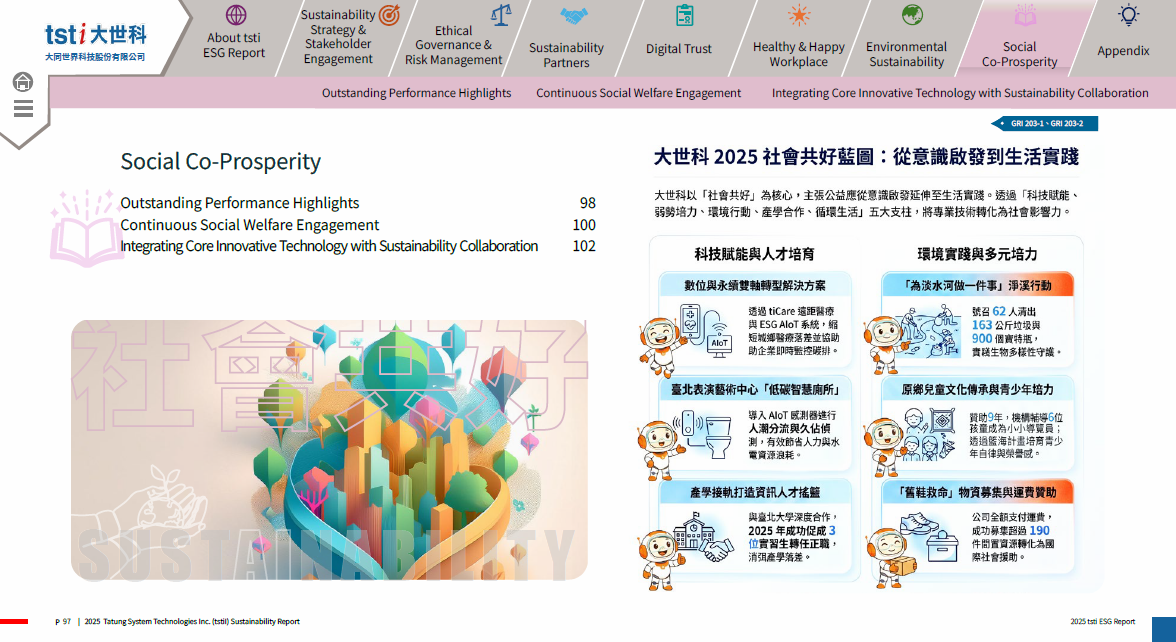
In Chapter 7: Social Co-Prosperity of the 2025 ESG Report, Tatung System Technologies Inc. (tsti) outlines its commitment to bridging digital divides, fostering community inclusion, and advancing environmental conservation. By combining employee volunteerism with its core Information and Communications Technology (ICT) expertise, tsti transitions its social initiatives from passive awareness to measurable, positive societal impacts.
The core dimensions and achievements of tsti's 2025 Social Co-Prosperity framework include:
1. Environmental Stewardship and Biodiversity Action
tsti actively encourages employees to transition from environmental awareness to field-based ecological action:
- Wetlands Education: In August 2025, tsti hosted a seminar titled "Discovering the Beauty of Wetlands" to educate employees on the Tamsui River basin ecosystem and the critical challenges facing wetland biodiversity.
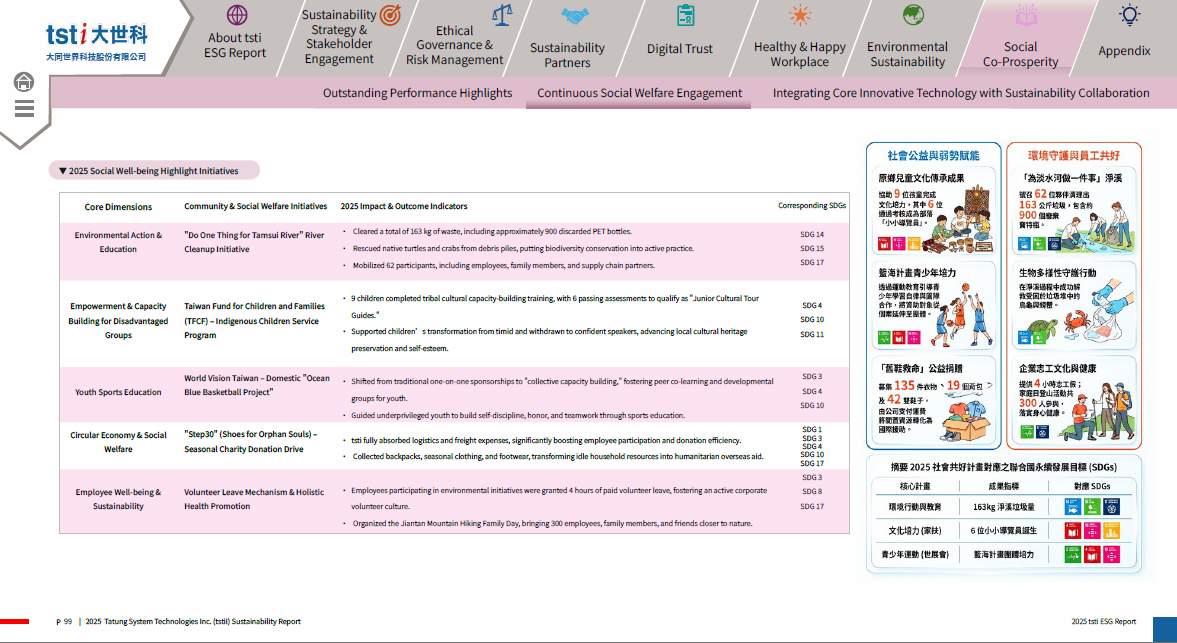
- Tamsui River Cleanup: In November 2025, a joint force of 62 volunteers—comprising employees, family members, and supply chain partners—mobilized for a river cleanup campaign along the Tamsui River basin. They successfully cleared 163 kg of waste (including approximately 900 discarded PET bottles) and rescued native wildlife (such as turtles and crabs) trapped in debris.
- Volunteer Incentives: To foster a hands-on corporate volunteering culture, employees who participated in environmental campaigns were granted 4 hours of paid volunteer leave.
2. Disadvantaged Empowerment and Youth Support
tsti coordinates long-term, structured support systems in remote and underprivileged communities to build capacity and preserve local cultural heritage:
- Indigenous Children Service Program: Entering its 9th consecutive year of partnership with the Taiwan Fund for Children and Families (TFCF), this initiative trained 9 children through tribal cultural capacity-building courses. Crucially, 6 of these children successfully passed evaluations to qualify as "Junior Cultural Tour Guides," helping them build self-esteem and preserve tribal traditions.
- Ocean Blue Basketball Project: In partnership with World Vision Taiwan, tsti reallocated educational sponsorship resources toward this structured sports program to guide underprivileged youth in cultivating self-discipline, honor, and peer co-learning.
- Step30 "Shoes for Orphan Souls" Campaign: tsti organized a seasonal charity donation drive to collect clothing and footwear for humanitarian aid. Employees donated 135 pieces of clothing, 42 pairs of shoes, and 19 backpacks, and tsti fully absorbed all associated logistics and freight expenses to maximize donation efficiency.
3. Cultivating the Next Generation of ICT Talent
Recognizing that quality education is vital for a sustainable future, tsti acts as an active professional incubator:
- Academic Partnerships: tsti signed strategic Letters of Intent (LOIs) for academic collaboration with 3 higher education institutions. This includes a formal agreement with National Taipei University (NTPU), allocating an annual development budget of approximately NT$ 150,0000.
- Campus Outreach: The company expanded its recruitment pipelines by conducting 2 corporate campus visits, 1 in-person campus recruitment seminar, and 1 virtual recruitment session across 4 target universities.
- Internship-to-Hire Pipeline: By integrating participating students into real-world software and technology projects and running structured performance evaluations, tsti successfully converted qualified interns into full-time employees in the second half of 2025.
4. Smart Governance and Technology for Social Good (Digital Enablement)
tsti leverages its core ICT systems integration capabilities to build digital public infrastructure that addresses urban-rural divides, public safety, and environmental challengess:
- Case Study I: AIoT Low-Carbon Smart Restroom Solution
- The System: Integrates environmental sensors (to track air quality and consumables) and millimeter-wave (mmWave) radar systems for privacy-preserving fall detection. It uses automated instant-messaging dispatch to optimize cleaning schedules, reducing municipal water/power waste and overcoming facility labor shortages.
- Deployment Milestones: Following installations at the Siraya Scenic Area (2023) and the Kaohsiung Port Cruise Terminal (2024), tsti successfully scaled the system in 2025 to manage event-driven crowds across 106 restrooms at the Taipei Performing Arts Center (TPAC).
- Case Study II: Taobao AI Quick Search (Taoyuan City Government Partnership)
- The System: To dismantle barriers to accessing complex government open data, tsti integrated its proprietary ibo.ai Enterprise AI Assistant Platform with the Taoyuan Residential and Real Estate Information Portal.
- Social Impact: Citizens and senior demographics can query real estate actual price registrations via conversational text or voice prompts. The platform eliminates 90% of conventional query steps and runs uninterrupted 24/7.
- Achievements: The portal has surpassed 40 million cumulative visits.This public-private partnership won the "Best Application System Award" at the 21st Golden Map Awards, conferred by the Taiwan Geographic Information Society (TGIS).
5. Sustainable Living Practices
tsti weaves sustainability directly into the workplace culture, making carbon reduction a natural habit:
- Employees actively champion low-carbon, plant-based mealss.
- The company enforces turning off office lights for one hour during the daily lunch break and supports global Earth Hour initiatives.
- In October 2025, tsti hosted a Family Day hiking event at Jiantan Mountain, bringing 300 employees and family members closer to nature while boosting physical fitness.
Please refer to the Sustainability Report [PDF] relevant chapter for more details.