

| Environmental Sustainability
Primary Operational Footprint & Policy
Because Tatung System Technologies Inc. (tsti) and its Taiwan subsidiaries are professional ICT system integration and service providers, they operate no manufacturing plants or heavy industrial machinery. Consequently, the group's environmental footprint is primarily associated with routine office operations, including office waste, water, electricity usage, company vehicles, and refrigerants.
To institutionalize its environmental commitments, the company enacted its official "Environmental Policy" in 2022, framing environmental sustainability as a company-wide mission.
Climate Change Governance (TCFD & SBTi Alignment)
tsti manages climate risks and opportunities through established international reporting frameworks and board-level oversight:
- Strengthened Risk Oversight: On December 19, 2025, the Board of Directors formally resolved to establish the Sustainable Development and Risk Management Committee (and approved its organizational charter) to review environmental strategies and targets at least once annually.
- IFRS Sustainability Roadmap: tsti established a cross-departmental IFRS Project Taskforce in late 2024 to execute a pilot adoption schedule for the IFRS Sustainability Disclosure Standards ahead of the official 2028 regulatory deadline.
- SBTi 2030 Carbon Reduction Pathways: tsti aligned its decarbonization goals with the Science Based Targets initiative (SBTi) methodologies, declaring a long-term goal to achieve a 20% carbon reduction by 2030 compared to its 2023 baselinee. This roadmap is divided into targeted segments:
- Reduce Scope 1 fuel consumption from company vehicles by 5% to 10%.
- Reduce Scope 2 purchased electricity emissions by 10% to 15%.
- Reduce Scope 3 emissions by 10% to 20%.
2025 Key Achievements & Environmental Milestones
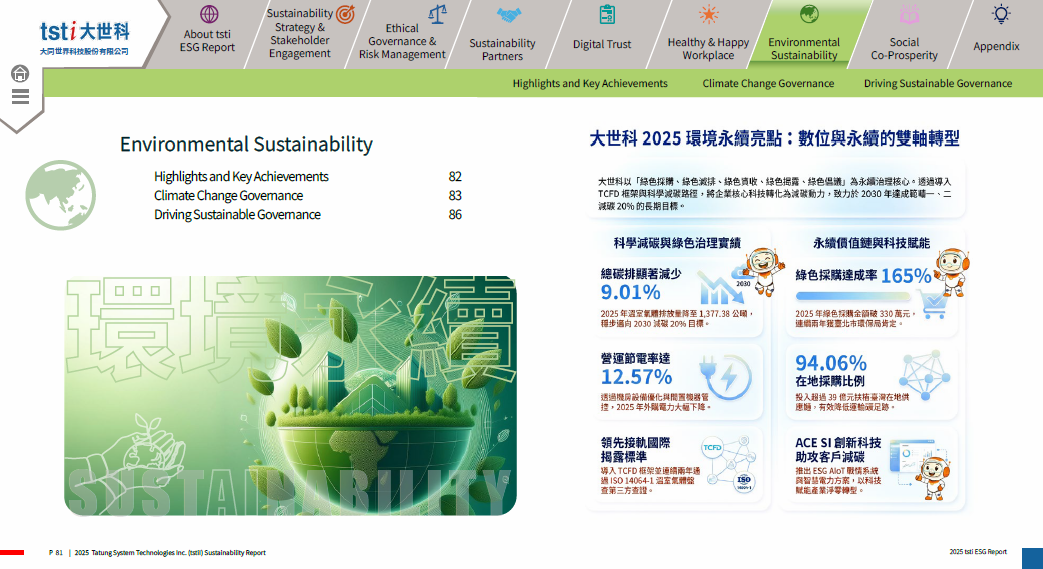
During the 2025 fiscal year, tsti translated its environmental policies into significant quantitative reductions across several operational areas:
- Significant Greenhouse Gas (GHG) Reductions: In 2025, tsti's total GHG emissions reached 1,377.3881 metric tons of CO2e, marking a 9.01% decrease compared to the previous yea.
- Scope 1 (Direct): 82.0372 metric tons CO2e (5.96%), stemming mostly from corporate vehicle gasoline and septic fugitive emission.
- Scope 2 (Energy Indirect): 945.5097 metric tons CO2e (68.65%), originating from purchased electricit.
- Scope 3 (Other Indirect): 349.8412 metric tons CO2e (25.39%), covering commuting, copying paper, and toilet pape.
- Emissions Intensity: Heavily optimized from 0.43 (in 2023) and 0.38 (in 2024) to 0.27 metric tons CO2e per NT$ Million of revenue in 2025.
- Outstanding Electricity Savings: Electricity consumption in 2025 totaled 1,994,746.33 kWh, which is a 12.57% savings compared to 2024 and a 10.81% savings compared to the 2023 base yea. These savings were primarily achieved by carrying out comprehensive IT asset audits at the 4th-floor data center, enabling the company to decommission idle non-operational equipment and shut down unused machinery.
- Expanding Green Procurement: Total green procurement expenditures reached NT$ 3,308,279 in 2025 (a 165% execution rate against the NT$ 2 million target). The company received a consecutive Letter of Appreciation from the Taipei City Government under its "Private Enterprises and Organizations Green Procurement Evaluation and Recognition Program". Additionally, local procurement accounted for 94.06% of tsti's total procurement spending, reducing logistics-associated transport footprint.
Waste, Water, and Circular Initiatives
To drive a local circular economy, tsti has standardized resource recycling and office conservation guidelines:
- Waste Streams and Recycling: In 2025, tsti and its subsidiaries recorded 4.688 metric tons of non-hazardous waste. The company diverted 3.429 metric tons (73.14%) toward paper recycling (entrusted to professional vendors for secure hydro-pulping), while the remaining 1.259 metric tons went to incineration without energy recovery. tsti actively tracks waste transportation through clearance vendors' vehicle escort protocols to prevent data leaks and pollution.
- Office Packaging Reuse: At customer sites, tsti systematically collects packaging materials to reuse as air pillow cushioning or product packaging, yielding annual cost savings of approximately NT$ 6,600.
- Water Resources: Because tsti leases its office spaces, it does not possess direct water billing statements. All tap water originates from municipal supplies. To preserve water, tsti utilizes water-saving sensor faucets and carries out regular inspections to prevent pipeline leakage.
Low-Carbon Client Solutions & Employee Advocacy
tsti leverages its core ICT technology to empower clients in their net-zero journeys while fostering a green culture internally:
- Green Tech Offerings: The company offers low-carbon, adaptive solutions to its enterprise clients, including Greenergy (Energy & Carbon Pioneer), ESG AIoT Intelligent Command and Management Platforms, Low-Carbon AIoT Smart Restrooms, and tiCare Telehealth video consultation services.
- Professional Credentials: As of 2025, tsti has accumulated 17 certified sustainability employees, with credentials including ISO 14064-1 greenhouse gas internal auditors (8 employees), Corporate Decarbonization Strategy Planners, and ISO 14067 professionals.
- Education and Biodiversity Voluntarism:
- A total of 540 employee participant-times completed ESG training (accumulating 267 hours) in 2025.
- tsti sponsored the biodiversity course "Discover the Beauty of Wetlands", followed by stream cleaning and mountain hiking initiatives, accumulating 934 volunteer hours across 283 participant-times.
Please refer to the Sustainability Report [PDF] relevant chapter for more details.